Spontaneity Is a Line Item: The Bloated Empire Behind Every 'Unfiltered' Celebrity Moment
Somewhere in Los Angeles right now, a person with the job title "Authentic Moment Strategist" is reviewing a mood board. The mood board is for a celebrity's upcoming "candid" grocery run. The grocery store has been pre-selected. The lighting has been scouted. The slightly-too-big hoodie the celebrity will wear — chosen to signal relatable exhaustion — has been sourced, pre-distressed, and approved by three separate consultants. The paparazzi photographer waiting outside? He got a calendar invite.
Welcome to the Authenticity Industrial Complex, where being real is a full-time job for approximately 47 other people.
The Department of Looking Like You Don't Have a Department
Let's start with the numbers, because the numbers are genuinely unhinged. A mid-tier celebrity — someone with, say, 8 to 12 million followers and a Netflix project in post-production — can maintain a realness infrastructure that runs anywhere from $40,000 to $150,000 a month. That's not their glam team. That's not their publicist. That is specifically the budget allocated to making them appear as though they do not have a budget.
The line items read like a parody sketch that got greenlit by accident. There are "vulnerability schedulers" whose entire function is to identify the optimal week for a celebrity to post a no-makeup photo, cross-referenced against press cycles, rival celebrity news, and platform algorithm behavior. There are "digital intimacy consultants" who craft the specific grammatical imperfections in a celebrity's captions — the lowercase letters, the run-on sentences, the strategically placed typo — designed to signal that no one proofread this, even though four people proofread this.
And then there is the "pause coach." Yes. A pause coach. A professional who trains celebrities to insert the correct length of hesitation before answering interview questions, so that their responses feel thought-of-in-the-moment rather than rehearsed at a facility in Malibu the previous Tuesday.
The 'Unplanned' Outfit Is the Most Planned Thing in the Room
Fashion is where the authenticity theater gets particularly baroque. The unglamorous paparazzi photo — the one where a celebrity is photographed in sweats, carrying a green juice, squinting at their phone — is now one of the most choreographed images in popular culture.
Styling teams have entire sub-specialties dedicated to what the industry quietly calls "schlub work": the curation of outfits specifically designed to look like the celebrity grabbed whatever was closest. The science here is genuinely impressive and also completely deranged. The wrong kind of wrinkle reads as depressed. The right kind of wrinkle reads as busy and important. A coffee cup from the wrong chain signals try-hard. The correct chain signals neighborhood loyalty. Every single element is load-bearing.
One stylist — speaking anonymously because, ironically, talking about this would destroy the illusion she is paid to maintain — described the process as "reverse engineering what a person with no team would accidentally wear, and then making it intentional and repeatable." She said this without laughing. Respect.
Raw Instagram Stories and the Crew That Makes Them Raw
The "raw" Instagram story has become the celebrity content format of our era precisely because it appears to require nothing. Shaky camera. Weird lighting. The celebrity talking directly to the lens about something that feels half-formed and emotionally unguarded. It is, of course, the most produced content they make.
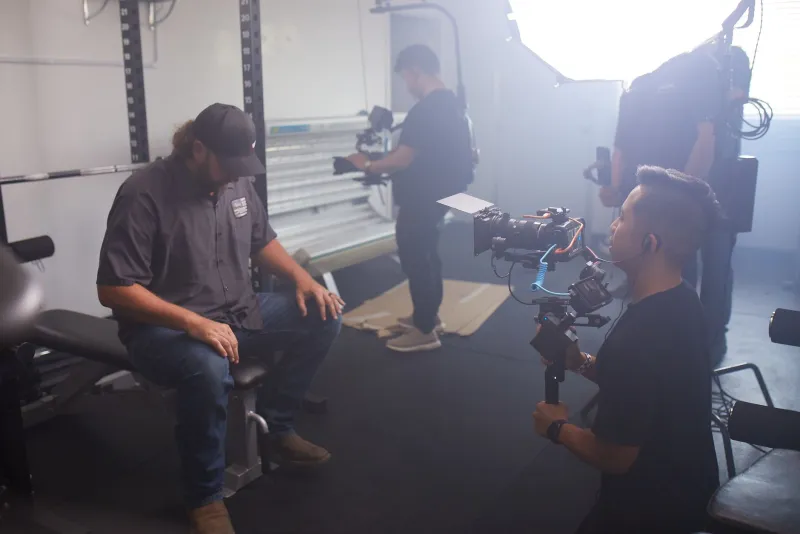
The infrastructure behind a single "raw" story moment can include: a creative director who identifies the emotional theme, a lighting consultant who designs the "bad" lighting (there is a difference between unflattering bad and authentically bad, and someone is being paid to know it), a speech coach who works on the specific vocal qualities — the slight crack, the trailing sentence — that register as unscripted vulnerability, and a social media strategist who times the post for maximum "I can't believe she just posted that" impact.
The actual filming often takes multiple takes. The takes are reviewed. Notes are given. The selected take is then processed to look like it was posted directly from the camera roll without a second thought.
The result is a 47-second video that feels like a window into a real human being. It is a window. The window was custom-fabricated and installed by a team.
Actual Spontaneity Is Now a Class Issue
Here is the part that should bother us more than it does: genuine, unmanaged, actually-real celebrity behavior is now something only the ultra-wealthy can afford to deploy strategically, and only the very famous can survive.
For a celebrity at a certain level of cultural saturation, an actual candid moment — something truly unplanned, unvetted, unstrategized — is a liability. It goes wrong. It gets clipped. It becomes a headline that requires its own response infrastructure. Real spontaneity, for these people, is genuinely dangerous.
So the ones who "seem" most authentic are often the ones with the largest teams ensuring that the authenticity never actually slips into something uncontrolled. The celebrities who read as the most human are the ones who have industrialized their humanity most completely.
Meanwhile, smaller creators — the ones who actually are just filming in bad lighting because they don't have a lighting budget — get algorithmically punished for not being polished enough, or praised briefly for their "rawness" before getting absorbed into a system that will teach them to manufacture that rawness at scale.
The Consultant Who Knows Too Much
The most telling detail in all of this is the existence of what some in the industry call "authenticity auditors" — people brought in specifically to review a celebrity's curated-realness content and flag anything that has become too obviously curated. Their job is to find the places where the performance of authenticity has gotten so professional that it has looped back around to seeming fake.
They then recommend adjustments to make the manufactured spontaneity feel more spontaneous. This is a job. Someone has a business card for this.
The recursion here is genuinely dizzying. You have people manufacturing realness, and then other people manufacturing the appearance that the realness isn't manufactured, and then auditors checking that the manufacturing of the appearance of unmanufactured realness doesn't itself look manufactured.
At some point — and we are well past that point — the word "authentic" stops meaning anything at all. It becomes a purely technical term, like "organic" on a bag of chips, signifying a process rather than a quality.
So What Are We Actually Watching?
None of this is to say the celebrities themselves are villains. They are, in most cases, people who got famous and then got immediately surrounded by an industry that profits from controlling every signal they emit. The machine that manufactures their realness was largely built around them, not by them.
But we should probably stop pretending that what we're consuming when we watch a celebrity's "unfiltered" moment is anything other than a very expensive, very sophisticated product. We are not glimpsing a real person. We are watching the output of a small company whose entire business model is the simulation of glimpsing a real person.
The celebrity is in there somewhere. Probably. Underneath the pause coach and the schlub-wear stylist and the vulnerability scheduler and the authenticity auditor.
Or maybe the celebrity is the company now. Maybe that's just what a person becomes when their realness gets a line item.
Either way, someone's getting paid for the hesitation before they answer.